Engineering
Machine Learning in 2026: How It Is Transforming Modern Businesses
Explore how Machine Learning is transforming businesses in 2026 through automation, predictive analytics, smarter decisions, and innovation.
Introduction
For instance, an online store might recommend a product you were already thinking of buying. Similarly, your bank may contact you to verify whether you made a particular transaction. These incidents do not happen by chance. Behind the scenes, intelligent systems analyze millions of data points to identify patterns and suggest appropriate actions.
This technology is called machine learning. It is an important part of modern AI development services. In 2026, it is transforming how businesses operate. For example, hospitals use intelligent systems to interpret medical scans, retailers predict customer demand, and financial institutions identify suspicious transactions. What once remained limited to research institutions and large technology companies has now become a practical solution for businesses of all sizes.
However, many business owners still have questions about adopting this technology. Is it affordable for small businesses? How much does implementation cost? What steps are required to get started?
This guide answers these questions in simple terms. We will explore how intelligent systems work in business, where companies are using them, their major benefits and limitations, and how you can implement these solutions in your organization.
What Is Machine Learning and Why Does It Matter in 2026?
By definition, machine learning means learning by examples rather than strictly adhering to a step-by-step instruction manual. The process involves providing large volumes of data to a system, which detects patterns and applies them when making predictions/decisions regarding other data samples.
For example, showing thousands of already-classified emails (as either spam or not-spam) to the system gradually teaches it how to recognize spam. With time, the system starts classifying emails on its own and continues to improve through practice.
How Machine Learning Technology Has Grown Up
Some time ago, creating some kind of valuable solution using machine learning technology implied having a team of specialists, powerful hardware, and several months of development time. All this has changed since then. Now, cloud providers offer pre-built solutions, computing costs are more affordable, and custom software development makes it easier to build machine learning solutions tailored to specific business requirements.
Thus, it's safe to say that 2026 looks like the time when machine learning technology has become mature, affordable, and user-friendly enough for medium-size businesses.
Artificial Intelligence and Machine Learning: What's the Difference?
Many people treat both concepts as synonymous, but that is incorrect. Artificial intelligence and machine learning are closely related technologies that play an important role in artificial intelligence in business, helping organizations automate operations and make smarter decisions. The first one is a general concept aimed at intelligent behavior of machines, whereas the second one is one of the approaches used to achieve it through learning from the data.
In other words, all of the tools currently applied by businesses as artificial intelligence, from chatbots to recommender engines, are machine learning-driven.
Understanding Machine Learning Models
A model is what "learns" on your data. There are various machine learning models suitable for different purposes. Some specialize in classification – distinguishing loyal customers from churners, for example. Other models forecast values, like sales of the next month. And some identify patterns without any specific request while others, like models that fuel modern language technologies, work with text.
The appropriate model selection varies depending on the task. Your development partner should help you pick the one depending on the needs and not just hype.
How Machine Learning Is Transforming Modern Businesses
This technology really comes into play when put to use on a day-to-day basis. Let's take a look at how this technology is being applied by various organizations.
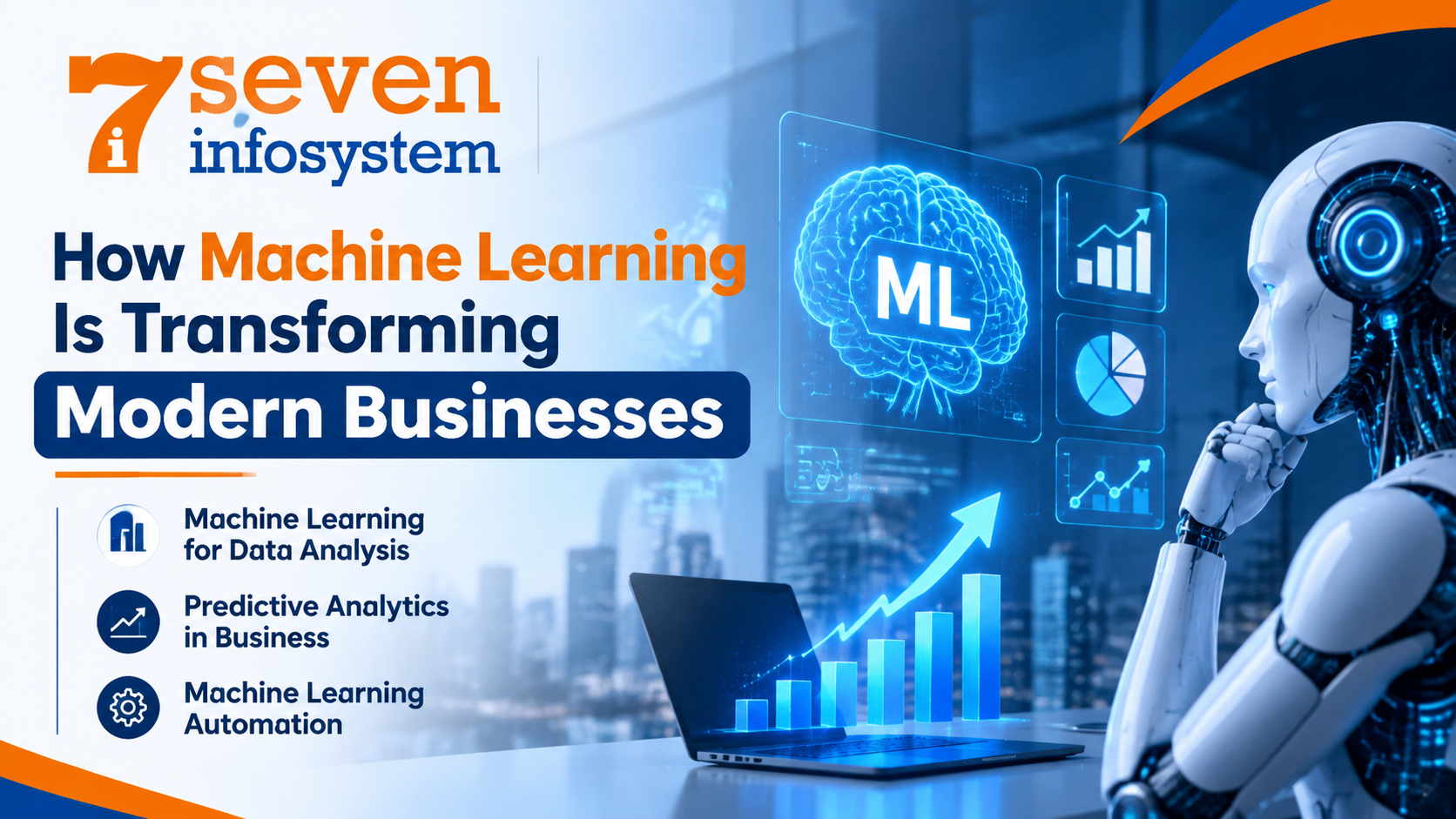
Machine Learning for Data Analysis
Almost all companies collect huge amounts of data but use only a small portion of it effectively. However, intelligent data analysis tools can process sales records, website analytics, customer feedback, and operational information much faster than manual methods.
Instead of waiting weeks to prepare reports, managers can quickly identify popular products, understand where sales are declining, and recognize customers who have not made recent purchases. Moreover, these systems can detect unusual patterns, such as a sudden increase in product returns. As a result, businesses can make informed decisions, respond to problems earlier, and improve their overall performance.
Predictive Analytics in Business
Reviewing the past is useful; predicting what lies ahead is much more useful. Predictive analytics in business applies previous data to predict upcoming events including demands, customer turnover, cash flows, or machinery failure.
A retailer prepares to offer relevant merchandise during the festival period. A manufacturer is ready to service machinery before its breakdown. A subscription-based company communicates with potential subscribers who are likely to cancel their subscriptions. Those are minor actions, but all together they result in substantial savings.
Machine Learning Automation
Each company has operations that take a lot of time but do not require much creativity: invoice processing, email filtering, document classification, record keeping. Machine learning automation performs these operations, and in contrast to traditional rule-based software, processes real-world, ambiguous data.
It recognizes handwritten bill in an uncommon format, analyzes customer dissatisfaction, associates payments with particular accounts. People make important decisions, but not anymore they spend their time on mundane tasks.
Machine Learning Applications Across Key Industries
Another factor that has fueled its rapid proliferation is the adaptability to just about any sector. Here are some examples of machine learning applications in various sectors.
Machine Learning in Healthcare
Healthcare facilities handle large amounts of data, where even a minor detail can make a significant difference. Intelligent systems help doctors identify potential illnesses through X-rays and other medical scans. They can also predict which patients may need additional treatment and reduce paperwork through more efficient digital record systems.
Furthermore, these technologies support hospital planning and daily operations. For example, predictive tools can estimate bed requirements, improve staff scheduling, and help hospitals manage resources effectively. However, they do not replace doctors or medical professionals. Instead, they provide valuable insights that support faster analysis and more informed medical decisions.
Machine Learning in Finance
One of the early adopters was the banking industry, and that should come as no surprise. Applications of machine learning in finance include real-time fraud detection, equitable credit scoring, streamlined loan processing, and personalised financial guidance.
Whenever your bank prevents a fraudulent charge in a matter of seconds, it is a trained model assessing how the transaction differs from your regular activity pattern. The same principle underlies fairer policy pricing and quicker claim resolution for insurers.
Machine Learning in E-commerce
E-commerce is one of the sectors where users frequently interact with intelligent algorithms without even realizing it. For example, online shopping platforms analyze customer preferences to suggest relevant products. These systems also support dynamic pricing, improve search results, and predict inventory requirements. As a result, businesses can offer personalized shopping experiences, manage stock more efficiently, and make better pricing decisions.
Besides, it helps retailers reduce returns by recommending the right products, detecting fake reviews, and sending promotional emails in real time, while business application development can bring these intelligent features into customized e-commerce platforms. For online merchants with limited budgets, even a rudimentary recommendation engine can raise average purchase prices significantly.
Manufacturing, Logistics, and Beyond
But it does not end here. Manufacturers use it to conduct quality inspections and maintenance. Logistics firms use it to optimize their delivery plans and reduce costs on fuel. Online education systems use it to customize their lessons, while travel companies use it to adapt prices and offer tours depending on their customers’ needs.
Even conventional industries like agriculture and real estate are not alien to the use of data science anymore. Agriculture employs it for yield forecasting and irrigation, while real estate companies employ it to determine appropriate pricing and identify potential locations of future development. Wherever there is data, there is room for learning from it.
Key Benefits for Growing Companies
But what exactly do businesses gain from adopting this technology? The benefits go far beyond saving a few hours of manual work each week. Intelligent systems help companies make better decisions, improve productivity, understand customer behavior, reduce operational costs, and identify new growth opportunities.
Better and Faster Decisions
Managers will no longer be bound by their instincts alone. They will be able to quickly adapt to any change in the market due to the precise forecasts and insights provided at once, unlike managers of competing companies that rely on monthly reporting.
Lower Costs and Fewer Errors
The automation of routine processes will eliminate the number of errors caused by fatigue and the need for human intervention when dealing with routine processes.
Personal Experiences at Scale
It was once easy to treat all clients like individuals only if there were just a few dozen regulars at a small store. But now companies are able to address thousands of individuals in their communications, promotions, and product suggestions, and all of that can be done in a personal way.
Systems That Improve Over Time
Conventional software is designed to perform specific tasks based on predefined instructions. However, intelligent models can learn from new information and improve their accuracy over time. As more data becomes available, they can identify patterns, adapt to changing situations, and deliver better results.
Stronger Security
Detection of strange login activities to fraud detection, the machine learning models detect patterns that are difficult to be noticed by humans.
Building the Right Solutions for Your Business
Understanding the advantages is just half of the equation. The other part is getting things done. Here's how businesses are handling the challenge in 2026.
Off-the-Shelf Tools vs Custom Software Development
Many ready-made solutions offer advanced features. For example, they are often sufficient for basic requirements such as email filtering, customer support chatbots, or automated responses. However, when your business has unique operations, data, and customer needs, these standard tools may not deliver the desired results.
Custom software development helps overcome this limitation. A solution designed around your business data and workflows can provide more relevant insights and accurate results. Moreover, well-designed intelligent applications can integrate with the tools your team already uses. As a result, businesses can improve efficiency without completely changing their existing systems.
The Machine Learning Development Process
Successful machine learning development requires a structured approach, similar to the process followed in software product development, from identifying business requirements to building, testing, and maintaining the final solution.
Define the problem: Focus on just one objective, like minimizing churn rates or increasing the speed of invoice processing.
Prepare the data: Make sure that the data used for training is clean and organized.
Choose and train a model: Experiment with several models and see which works best.
Test with real users: Do a pilot run and test the results objectively.
Deploy and monitor: Deploy the model, track its accuracy, and periodically retrain it.
Not performing data preparation is the most common cause of failure in machine learning development. The model can only be as effective as the data used to train it. It's also useful to set the standards of success before even starting your work, such as time saved or errors reduced.
Choosing Machine Learning Services and a Tech Partner
Not all businesses make everything on their own since they do not have to do so. ML services can handle everything from strategizing and data preparation to model creation, implementation, and maintenance.
When selecting a technical partner, choose one who provides not only IT skills but also consultancy services. The ideal technical partner should begin by analyzing your business challenges and suggest the right software technology solutions rather than the most complicated one. Many businesses today prefer working with a software development firm in India because of their abundance of talent, different engagement models, and lower costs, while delivering quality results.
Enterprise Software Development and Business Application Development
Larger corporations usually need models that integrate smoothly with enterprise resource planning (ERP) software, customer relationship management (CRM) systems, data warehouses, and security tools. This integration helps businesses manage information efficiently and improve overall operations.
For small and medium-sized businesses, business application development provides access to similar intelligence through practical tools. For example, a sales application can help prioritize leads, while an inventory dashboard can send alerts before stock runs out. Moreover, these solutions make advanced technologies more accessible and affordable. As a result, businesses of all sizes can benefit from AI-powered applications and intelligent automation.
Challenges to Keep in Mind
While this technology has many advantages, one needs to have reasonable expectations before getting started.
Data Quality
In case you work with incomplete, out-of-date, or spread across different spreadsheets data, then results would be inconsistent. Many projects dedicate much more time for preparing data rather than modeling.
Privacy and Security
These algorithms often require access to sensitive customer or financial information to deliver accurate results. Therefore, businesses must follow applicable data protection laws and regulations. They should also implement strong security measures, control data access, and ensure that personal information is collected and used responsibly.
Bias and Transparency
When historical data is biased, a model may be biased as well. This issue plays a significant role when recruiting people, giving loans, and setting prices. Periodical review and transparency of models allow for making unbiased and justifiable decisions.
Skills and Change Management
Even the best technology will not work without skilled users. Your company needs to train staff, explain benefits of new technology, and include them into the process of implementation.
The Future: Digital Transformation With AI
Moving forward, the future of technology will be shaped by AI-driven digital transformation, with intelligent systems becoming an essential part of everyday business operations. Intelligent components shall be included in all software that people open at work, and querying one’s own data shall become as natural as searching on the internet.
Moreover, we see the emergence of intelligent agents capable of handling multi-step actions such as research of suppliers, quotation comparison, and summarizing everything into a report. The combination of these intelligent business solutions along with edge computing and real-time analysis using advanced IT solutions will enable businesses to react to changes in a matter of hours as opposed to weeks.
These companies shall not be those which pursue every possible trend, but those which possess well-structured data, clear objectives, and people capable of working with intelligent software.
Conclusion
Machine Learning is no longer experimental; instead, it has become an essential part of modern business operations. Today, businesses use intelligent technologies to analyze data, predict future trends, automate tasks, and deliver personalized customer experiences. Whether you operate in healthcare, finance, retail, or manufacturing, these solutions can create new opportunities for growth.
However, successful implementation requires the right approach. First, identify your business goals and prepare quality data. Also, choose an experienced technology partner who understands your requirements. Start with smaller projects and gradually expand as you see results.
Most importantly, consider this technology a smart assistant that supports human decision-making rather than replacing it. For example, businesses can use data-driven insights to make better decisions while allowing teams to focus on strategic activities.
Finally, if your company is ready to embrace digital transformation, consulting an experienced technology partner can be a valuable first step. With the right strategy and expertise, you can turn intelligent automation into a long-term business advantage.
FAQs
1. What is machine learning in simple terms?
It's a way for computers to learn from data and examples, so they can make predictions or decisions without being programmed for every situation.
2. How can small businesses use machine learning?
Small businesses can use it for sales forecasting, customer recommendations, chatbots, fraud checks, and automating routine tasks like data entry.
3. Is machine learning expensive to implement?
Not necessarily. Cloud tools and ready-made models have lowered costs, and starting with a small pilot keeps the investment manageable.
4. Which industries benefit most from machine learning?
Healthcare, finance, e-commerce, manufacturing, and logistics see strong results, but almost any industry with data can benefit.
5. How long does a machine learning project take?
A focused pilot can take a few weeks to a couple of months, while larger enterprise projects may take several months depending on data and complexity.