
Best Architecture of Microservices: A Complete Guide for Modern Applications
Learn the Architecture of Microservices, including patterns, benefits, principles, challenges, and best practices for modern applications.
Introduction
Modern applications have to deal with users all the time. They also need to update, connect with systems, and handle more complicated business needs. Small systems can work with monolithic applications. When an application gets bigger, handling one big codebase can be hard. That is when the Architecture of Microservices can offer a way to build applications through custom software development.
Microservices architecture splits an application into parts. Each part can be deployed on its own. Each part deals with a business task. These parts talk to each other using ways, usually APIs. This way teams can grow parts of the application. They can release features more often.
Microservices are not always the best choice. They add things to manage. There is infrastructure to handle. There is monitoring to do. There is security to think about. There is testing to perform. There is more work to handle operations. So deciding to use this approach should depend on the size of the application. It should depend on the business needs. It should depend on the skills of the team.
What Is Microservice Architecture?
A microservices architecture is a form of software design that breaks an application into multiple small components, with each component performing a specific business function. As a result, each component can operate independently while contributing to the overall application.
For example, a microservices architecture for an online shopping website might include the following modules:
User authentication service
Product catalog service
Payment service
Notification service
Inventory service
Instead of placing all functionality into a single large-scale application, each service handles a specific business function. This approach also allows teams to manage individual services more efficiently.
Each service can have its own database, business logic, lifecycle, and technology stack where necessary. In addition, services can interact with each other through REST APIs, message brokers, or event-based communication.
Therefore, this architecture allows teams to make changes to a particular business capability without rebuilding or redeploying the entire application. Finally, this independent approach can help teams develop and evolve different parts of an application more efficiently.
How Microservices Architecture Works
Understanding how microservices architecture works requires looking at how individual services interact within a larger application.
A typical request might follow this process:
A customer opens an application.
First, the request reaches an API gateway or another entry point.
Next, the gateway routes the request to the appropriate service.
Then, the service processes the business logic.
If required, it communicates with other services.
After that, the relevant data is retrieved or updated.
Finally, the service returns a response to the client.
For example, when a customer places an order, the order service might communicate with the inventory service, payment service, and notification service. As a result, each service can perform its specific task without depending on one large application component.
This approach makes the system more flexible. Also, developers need to pay close attention to how services communicate with each other. Because multiple services can exchange data, teams need to maintain data consistency, monitor system activity, and handle failures properly. Therefore, effective communication and reliable operations play an important role in making microservices architecture work successfully.

Core Components of Microservices Architecture
Successful microservices architecture consists not only of individual services but of several supplementary components that facilitate communication and reliable operation of the services.
1. Microservices
Every microservice embodies a specific business functionality. An appropriate service boundary must always take into account business capabilities rather than divide an application into its arbitrary components.
2. API Gateway
API gateway in microservices architecture serves as an entrance point from the client side to the backend services. It performs tasks such as request routing, authentication, rate limiting, logging, etc.
For instance, a mobile application can perform requests to the gateway and not deal with ten different services.
3. Service Discovery
Dynamic environments require a lot of changes in the instances of services. Thus, service discovery is used for discovering available instances of services by applications.
4. Database or Data Storage
Depending on the needs of the system, microservices can either have their own databases or data stores. Independent data ownership helps decrease dependencies between services.
5. Message Brokers
Message queues and event-streaming platforms can be used by the services to communicate in an asynchronous manner.
Microservices Architecture Patterns
There are several microservices architecture patterns that can help solve architectural problems.
API Gateway Pattern
The API gateway provides an entry point for clients and routes requests to appropriate backend services. It can also support authentication, throttling, request transformation and monitoring.
Database-per-Service Pattern
Under this approach each service owns its data. This can improve service independence. May make transactions and reporting across multiple services more complex.
Saga Pattern
The Saga pattern helps manage distributed business transactions by breaking them into local transactions. If a later operation fails, compensating actions can be used to maintain business consistency.
Event-Driven Architecture
Services consume events instead of relying exclusively on synchronous requests. This can improve decoupling and enable processing.
Circuit Breaker Pattern
A circuit breaker helps prevent repeated requests, to a service. By allowing failures to cascade throughout the system requests can be temporarily stopped or redirected.
Choosing among these patterns depends on the application's requirements. A development team should introduce a pattern because it solves a problem rather than adopting it simply because it is popular.
Microservices Design Patterns and Their Role
Microservices design patterns provide reusable solutions for common issues in distributed systems. For example, teams can use these patterns to address communication, service discovery, fault tolerance, and other architectural requirements.
Therefore, a system might use API gateways to manage client access, service discovery to identify services, circuit breakers to improve fault tolerance, and asynchronous messaging to support loosely coupled communication.
However, the number of patterns a system uses matters less than whether each pattern helps meet a specific architectural requirement. Also, teams should choose patterns based on the application's actual needs rather than adding them unnecessarily.
Because over-engineering can introduce extra infrastructure and unnecessary overhead, teams should keep the architecture as simple as possible. For example, a small application might work effectively without complex distributed-system elements.
Microservices vs Monolithic Architecture
The discussion around microservices versus architecture is not about one architecture being better than the other in every case. Both microservices and monolithic architecture have reasons to be chosen.
A monolithic application usually keeps its functions inside one deployable unit. Microservices function into many services that can be deployed on their own.
Monolithic Architecture
A monolithic system can provide:
Simpler initial development
Straightforward deployment
Easier local testing
Lower operational complexity for small applications
However, as the system grows, tightly coupled components can make large changes more difficult. A small modification may require rebuilding and deploying the entire application.
Microservices Architecture
Microservices can provide:
Independent deployment
Service-level scalability
Clear business boundaries
Technology flexibility
Better isolation of certain failures
The trade-off comes with added complexity. Developers have to handle networking, service communication, distributed logging, monitoring, security, deployment automation and possible data consistency problems.
Because of these challenges the choice between monolithic and microservices should be based on project needs. It should not just be seen as a competition between technologies.
Microservices Application Architecture
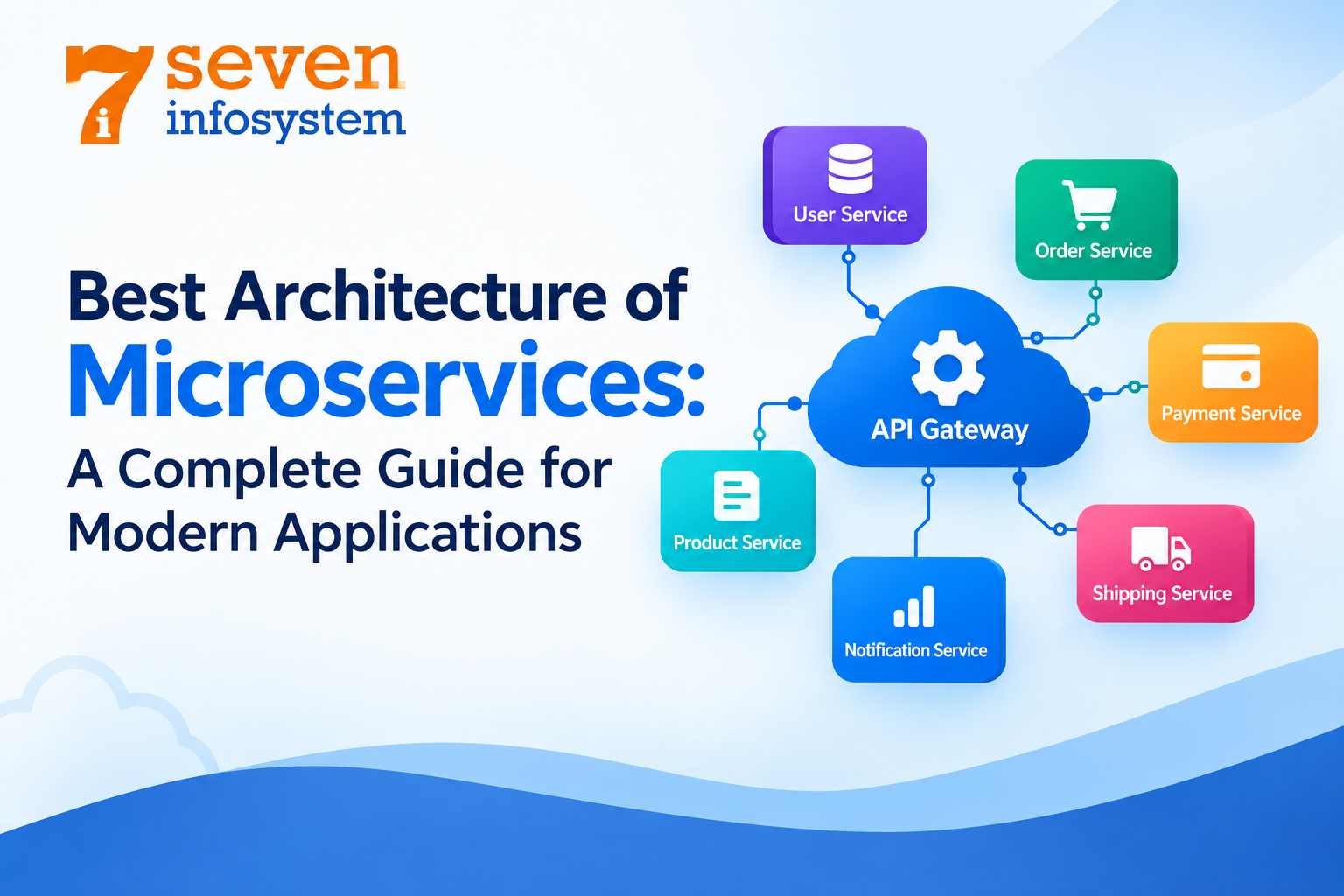
At the client layer users connect using web apps, mobile apps or other interfaces. Their requests go to an API gateway or a load balancer.
Behind the gateway there are business services, like authentication, product management, payments orders and notifications. These services talk to each other using APIs or messaging systems.
A data layer holds the information tied to each service. Monitoring tools and infrastructure support the system.
The exact setup changes a lot from one project to another. A small app might use a few services. A big enterprise platform could have dozens or even hundreds.
Scalable Microservices Architecture
The scalable architecture enables services to scale independently based on their demand.
To take an example, suppose there is an online shopping portal where the traffic on the product catalog service is much more than that of the notification service. In such a case, with microservices architecture, the scaling of the product service is possible without cloning the whole application.
Horizontal scaling may include the running of several instances of services through a load balancer. Containerization and automation tools further help in deployment and scalability.
Nevertheless, just because microservices enable the creation of more services does not mean that scalability is possible. The bottlenecks might emerge within the databases, message queues, network calls, and third-party services.
What Is a Microservices Architecture Diagram?
A microservices architecture diagram search generally refers to a visual representation showing how services, clients, APIs, databases, gateways, and infrastructure components interact.
A simplified architecture might look like this:
Users → Web/Mobile Application → API Gateway → Microservices → Databases
The microservices layer could include:
Authentication Service
Product Service
Order Service
Payment Service
Notification Service
Communication between services happens using REST APIs, gRPC, message queues or event streams.
An architecture diagram is important because distributed systems can be hard to figure out by looking at code. A good diagram makes it easier for developers, architects, project managers and people who care about the project to see where the system starts and ends and how different parts connect.
How to Design Microservices Architecture
If you are wondering how to design microservices architecture, begin with business requirements rather than technology choices.
Step 1: Identify Business Capabilities
identify business capabilities. Break the application into business functions. For an e‑commerce platform these could be customers, products orders, payments and inventory.
Step 2: Define Service Boundaries
Define service boundaries. Each service should have a responsibility. Avoid creating small services simply for the sake of having more microservices.
Step 3: Define Communication
Define communication. Decide whether services should talk synchronously through APIs or asynchronously through events and messaging.
Step 4: Establish Data Ownership
Establish data ownership. Decide which service owns each piece of business data. Shared databases can create coupling and should be evaluated carefully.
Step 5: Design for Failure
Plan for failure. Network failures, unavailable services, timeouts and partial failures are normal in distributed systems. Use strategies, timeouts, circuit breakers and fallback mechanisms.
Step 6: Plan Security
Plan security. Include authentication, authorization, encryption, secrets management, API security and service‑to‑service access controls, from the start.
Step 7: Build Observability
Build observability. Use logging, metrics, distributed tracing and alerting to diagnose issues across services.
Step 8: Automate Deployment
Automate deployment. CI/CD pipelines help teams test and deploy services consistently. Infrastructure automation reduces operational work.
Microservices Architecture Design Principles
Several microservices architecture design principles can guide development teams.
Single Responsibility
A service should focus on a clearly defined business capability. This makes its purpose easier to understand and maintain.
Loose Coupling
Services should minimize unnecessary dependencies on each other. Changes in one service should not require extensive changes across unrelated services.
High Cohesion
Related functionality should remain together within an appropriate service boundary.
Independent Deployment
Services should ideally be deployable independently when business and technical requirements allow it.
Resilience
Applications should be designed to handle service failures gracefully rather than assuming every dependency will always be available.
These principles are more useful when treated as practical guidelines rather than rigid rules.
7 Principles of Design in Architecture
The 7 principles of design in architecture can vary depending on the field and its specific requirements. In software architecture, however, several key ideas stand out. These include simplicity, modularity, scalability, maintainability, security, reliability, and adaptability.
When teams apply these principles to microservices, they can shape how they build and manage each service. For example, teams should define clear service boundaries so each part remains easy to understand. Also, they should remove unnecessary complexity and keep each service focused on its purpose.
Because applications can grow over time, teams should plan for scalability from the beginning. In addition, they must prioritize data security and design systems that can handle failures without bringing down the entire application. Finally, the architecture should support continuous change so teams can adapt services as business and technical requirements evolve.
Benefits of Microservices Architecture
The benefits of microservices architecture can be significant for applications with complex business requirements and appropriate engineering maturity.
Independent Scaling: Individual services can be scaled based on their specific workload.
Faster Releases: Teams can potentially deploy individual services without releasing the entire application.
Better Fault Isolation: A failure in one service does not necessarily bring down the complete system, provided the architecture includes appropriate resilience mechanisms.
Team Autonomy: Different development teams can own different services and business capabilities.
Technology Flexibility: Services may use different technologies when there is a genuine technical or business reason to do so.
Easier Evolution: Individual services can be improved or replaced independently, reducing the need for large-scale changes to the entire application.
These advantages must be balanced against operational complexity, infrastructure costs, distributed data challenges, and the need for stronger monitoring and automation.
Use of Microservices Architecture in Modern Applications
The use of microservices architecture is common in systems that have multiple business domains, significant traffic, frequent deployments, or independent scaling requirements.
Potential use cases include:
E-commerce platforms
Banking and financial applications
Healthcare platforms
Logistics systems
For example, a SaaS platform might separate identity management, subscription management, billing, reporting, and notifications into individual services.
However, a small internal application with limited functionality may not need microservices. In such cases, a modular monolith can sometimes provide many organizational benefits without introducing distributed-system complexity.
Microservices Development Services
Organizations that do not have sufficient internal architecture or engineering resources may work with providers offering microservices development services.
When a microservice development company, businesses should look beyond the technology stack. Consider their approach to architecture planning, security, testing, documentation, deployment automation, monitoring, scalability, and long-term maintenance.
A reliable development process should begin with understanding business requirements and technical constraints before recommending a particular architecture.
The objective should not be to introduce microservices because they are modern. Instead, the architecture should solve identifiable business and engineering problems.
Common Challenges of Microservices
Despite their advantages, microservices introduce several challenges.
Distributed Complexity
A monolithic application may have internal method calls, while microservices communicate over networks. Network communication introduces latency and failure possibilities.
Data Consistency
Maintaining consistency across independently managed databases can be more complicated than handling transactions inside one database.
Monitoring
Debugging a request that moves through several services requires centralized logs and distributed tracing.
Security
Every service-to-service communication path can introduce additional security considerations.
Deployment Management
Multiple services require reliable CI/CD pipelines and infrastructure automation.
Testing
End-to-end testing can become more complicated because multiple services and dependencies must work together.
Understanding these challenges helps teams make informed architecture decisions rather than focusing only on the potential benefits.
Best Practices for Implementing Microservices
A practical implementation should start small and evolve based on real requirements.
Define clear service boundaries before development begins. Keep APIs documented and versioned where necessary. Establish ownership for every service and its data.
Use automated unit, integration, and end-to-end testing. Implement centralized logging and distributed tracing early rather than waiting until production problems occur.
Security should also be considered throughout the development lifecycle. Apply authentication and authorization consistently, protect secrets, encrypt sensitive communication, and regularly review dependencies.
Finally, monitor actual system behavior. Performance metrics and operational data can reveal whether the architecture is meeting its intended objectives.
Conclusion
The Architecture of Microservices provides a structured way to build complex applications as collections of focused, independently manageable services. For example, it can support scalability, independent deployment, team autonomy, and flexible system evolution when implemented appropriately.
However, microservices also introduce real engineering challenges, including distributed communication, data consistency, monitoring, security, testing, and operational management. Therefore, teams need to consider these factors carefully before adopting a microservices approach.
Also, the most effective architecture is not necessarily the one with the greatest number of services. Instead, it is the one that aligns technology decisions with business requirements, application complexity, team capabilities, and long-term goals.
Before adopting microservices, evaluate your current architecture, identify specific limitations, define clear service boundaries, and establish the infrastructure required to operate a distributed system. With thoughtful planning and continuous improvement, microservices can become a valuable foundation for modern, scalable applications and IT solutions for businesses.
FAQs
1. What is the Architecture of Microservices?
The Architecture of Microservices divides an application into small, independent services, with each service handling a specific business function. These services communicate through APIs, messaging systems, or events.
2. How does Microservices Architecture work?
Microservices architecture works by allowing independent services to communicate and perform specific tasks. An API gateway can route requests to the appropriate service, which processes the request and returns the required response.
3. What are the benefits of Microservices Architecture?
Key benefits include independent scaling, faster releases, clear business boundaries, technology flexibility, and improved fault isolation. It can also allow teams to develop and deploy services independently.
4. How do you design Microservices Architecture?
Start by identifying business capabilities and defining clear service boundaries. Then plan communication, data ownership, security, failure handling, monitoring, and automated deployment.
5. What is the difference between Microservices and Monolithic Architecture?
A monolithic application typically operates as one deployable unit, while microservices divide functionality into independently deployable services. Microservices can provide greater flexibility and scalability but introduce additional operational complexity.