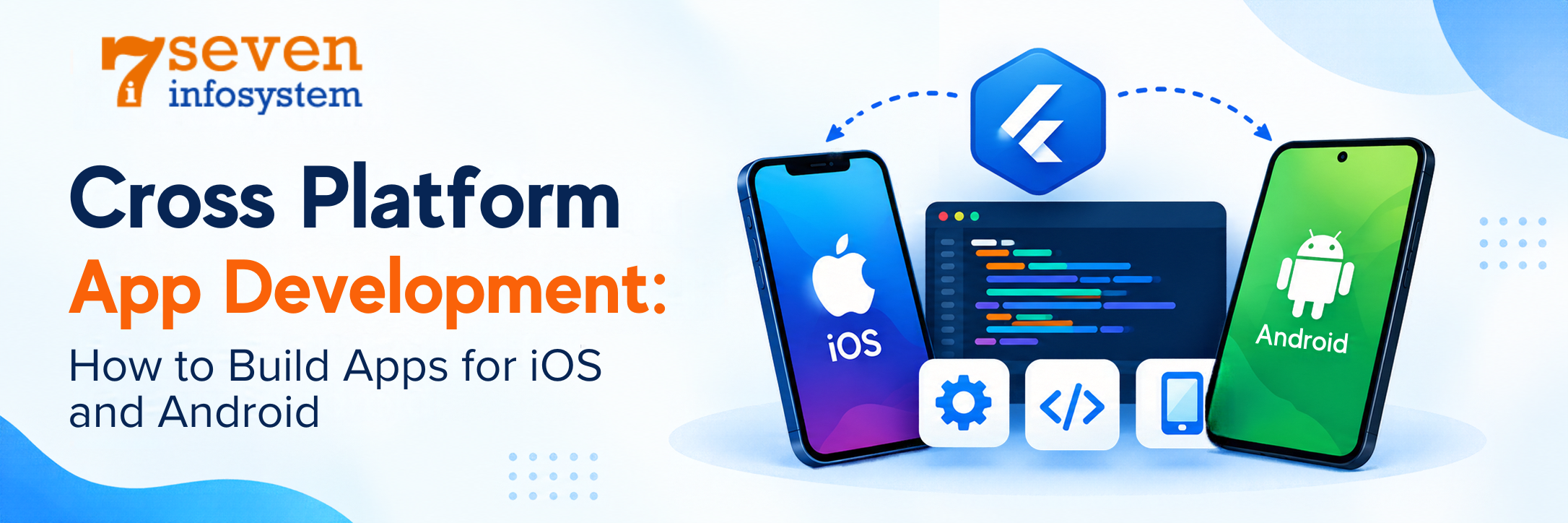
Cross Platform App Development: How to Build Apps for iOS and Android
Learn how cross platform app development helps businesses build scalable iOS and Android apps with efficient development, testing, and maintenance.
Introduction
Mobile apps have become a part of how businesses sell products, talk to customers, offer services and create lasting connections. Whether it is a shopping app, a reservation tool, a company internal tool, a financial service app or a service that people use on demand businesses are looking for an app that works well on both major mobile systems: iOS and Android.
In the past companies made one app for iOS and another for Android. Even though building native apps can give the performance for each platform, keeping two separate sets of code can make development harder, more expensive, take more time to test and be more work to maintain. Cross Platform App Development gives a way where developers can make one app that works on many platforms using one set of code.
This method can help businesses get their app out faster while making development easier to handle. New tools have also made -platform apps better giving access to phone features, good designs, testing options, connections, with other systems and ways to grow the app over time.
What Is Cross Platform App Development?
Cross Platform App Development refers to the creation of mobile apps that run on more than one operating system, usually iOS and Android, based on a largely common source code. Rather than building two independent applications, developers build and sustain a considerable part of the software in one project using a cross platform mobile application development framework.
This is not only about building an app that works in different environments. A good app also needs to have a unified user experience, reliable performance, adequate security, and proper access to the functionality provided by different platforms.
From the business perspective, this development method can help in simplifying the product development process as a company needs to develop its product only once using one strategy for all mobile platforms.
Cross Platform App Development company is especially useful, for startups, growing companies and organizations that want mobile coverage without repeating the entire development process.
Why Businesses Choose Cross Platform App Development
Reach iOS and Android Users With One Development Strategy
One of the greatest benefits is that it allows developers to cater to both the leading operating systems in one go. It is possible to develop one application which can be used by both the iPhone and Android users where a significant portion of the business logic will remain common.
Reduce Development Time
If there is the need to develop different native apps for iOS and Android, implementation and synchronization of those two are required separately. Using the same codebase allows the team to implement numerous features only once and reuse them for different platforms.
For those businesses that operate under tight deadlines, it helps deliver products quickly. Also, it enables the simultaneous release of updates on both platforms.
Control Development and Maintenance Costs
Development cost relies on things, such as features, design detail, integrations, security, testing and ongoing help. Using code can cut duplicate development effort in many projects.
This is why companies look at cross‑platform choices when judging app development company cost. By paying for a full separate build of the same business logic they might use one development team and a common architecture, for most of the app.
Cross Platform App Development Frameworks
The selected framework plays an important role when it comes to developing, maintaining, scaling, and integrating. All projects have their own technical requirements, and hence there isn’t a framework that suits all businesses.
Flutter
Flutter is a framework for building applications from a shared codebase. It provides a set of UI components and supports the creation of custom interfaces with consistent visual behavior.
Flutter can be an option for businesses that want a highly customized design and a unified development workflow, across mobile platforms. It is also frequently considered for applications that may later expand to supported environments.
React Native
Another framework that can be used for cross-platform mobile application development is React Native. React Native enables developers to develop mobile applications by using React and JavaScript-based technologies, with a lot of common code for iOS and Android.
This framework may be especially helpful for those who have experience developing websites with React. There are a variety of libraries and integrations available within this ecosystem that can help to meet requirements of typical mobile applications.
Xamarin and Other Options
Xamarin was previously used as cross-platform technology in the .NET ecosystem. Therefore, companies may face existing applications or teams who know technologies related to Xamarin. There are also other frameworks which can be taken into account.
What is important to note here is that developers should choose a framework depending on application needs, and not only its popularity.
iOS and Android App Development: How Does It Work?
The process starts with a product strategy. The team sets out the applications business needs, how users will move through the app, the features it will have, the design, the technical setup and what the platform should support.
Developers then build the shared business logic of how data is managed, APIs, how users log in and other parts that can be used in places. When the app needs something to a platform separate native parts or connections can be added.
For instance an app might use the login process, product list, shopping cart, payment system and API setup while using different settings for notifications, permissions, how the camera works or biometric login depending on the device.
This shows that cross-platform development is more flexible than thinking of it as "one codebase for all." The real goal is to use as much code as possible without making the experience on each platform worse.
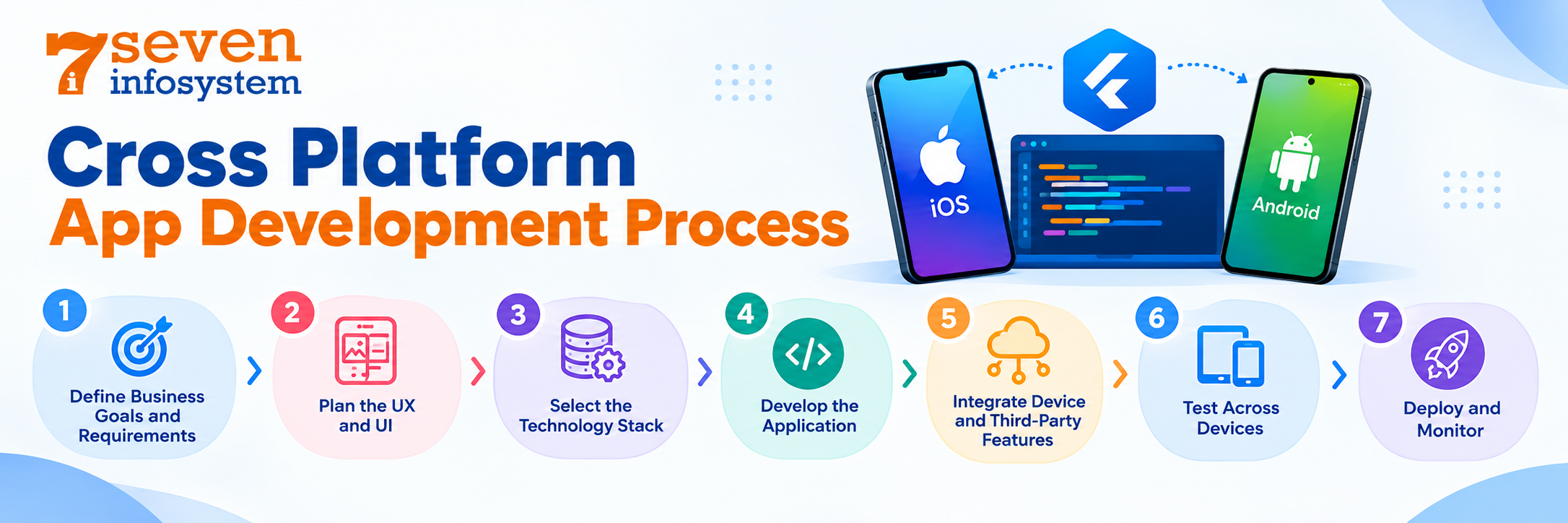
Cross Platform App Development Process
1. Define Business Goals and Requirements
Begin by figuring out who will use the app and what problem it needs to solve. It’s important to outline the project scope. This includes the features, the different types of users, any systems the app needs to connect with security needs, how the app will make money, how data will be tracked and how the app might grow in the future.
When the scope is clear the development team can better plan what resources are needed. It also keeps them from adding features that're n’t necessary in the first version of the app.
2. Plan the UX and UI
Designing an application starts from designing its experience rather than its technicalities. Wireframes and prototypes allow developers to get an understanding of the navigation, screen structure and interactions before implementing the actual design.
Your visual system should remain consistent for both iOS and Android. A great cross platform mobile application framework can make your life easier, but not the design itself.
3. Select the Technology Stack
I have seen that at this stage the team looks at the framework, programming language, backend architecture, database, APIs, cloud services, analytics tools and other integrations.
The chosen stack must keep the product working well and still allow for future improvements.
4. Develop the Application
I know that developers create the core features, backend connections, authentication, data flows, notifications, payments and other needed functions.
Reusable components can cut duplicated effort. Quality remains essential. Clean architecture, coding standards, version control, documentation and secure practices should be part of the process, from the start.
5. Integrate Device and Third-Party Features
Many applications depend on mobile device capabilities such as GPS, camera, microphone, contacts, Bluetooth, biometric authentication, or push notifications.
Third-party services may also include payment gateways, maps, customer support, analytics, cloud storage, or social login. These integrations should be tested carefully because platform behavior can differ.
6. Test Across Devices
An application cannot be deemed finished after testing on one mobile device or emulator. It must be tested across various screens, OS versions, networking conditions, permissions, performance and user scenarios.
It is at this point that cross platform app testing proves highly essential as not only functionality but also platform usability must be tested.
7. Deploy and Monitor
The application needs to go through a testing and approval process before the deployment to app stores.
Monitoring of crash logs, user feedbacks, analytics, performance data, and customer support requests is required.
Cross Platform App Testing
Testing is a crucial phase of app development because an application may behave differently across various devices, operating systems, screen sizes, and hardware configurations. Thorough testing helps ensure the app delivers a consistent, reliable, and user-friendly experience on both iOS and Android.
It is necessary to have in mind during the testing phase that good QA must include: functional testing, user interface testing, API testing, security testing, performance testing, compatibility testing, and regression testing.
In the testing phase it is very important to check the most important flows such as: sign up, log-in, search, checkout, payment, notifications, upload files, profile updates, and log out. It is also important to test applications on low network and different screen size devices.
Automation may help to perform testing several times easily, but still manual testing is useful. Cross-platform app testing should be done at an earlier stage not at the last stage of development.
Cross Platform vs Native App Development
Cross-platform and native development are dependent on what type of product is being developed, not vice versa.
Native development means building apps that are made for one platform. This usually involves using tools and languages that are designed for iOS or Android. This method can be an idea when the app needs to use special features that only work on one platform or when it needs really good graphics or a lot of custom behavior.
Cross-platform development on the other hand lets developers use the same code for more than one platform. This can help make the development process easier and make it simpler to release the app on devices.
Businesses should consider factors such as:
- How much platform-specific functionality the application needs
- Expected performance and animation requirements
- Development timeline
- Available engineering skills
- Long-term maintenance plans
- Budget and product roadmap
For business applications the ability to reuse code and keep a consistent product experience is what makes cross‑platform development so appealing. When dealing with specialized products one might still consider native development as another option.
How to Choose a Cross Platform App Development Company
Choosing the appropriate development partner can be crucial in terms of the quality of products and final outcomes. Companies need to analyze more than just a portfolio website and quotation.
A capable cross platform app development company must show experience with architecture UI/UX design, APIs, security, cloud services, testing, deployment and post‑launch support.
Ask partners about their development process, framework expertise, testing methods, communication style, project documentation, maintenance services and how they handle platform‑specific needs.
It is also helpful to review work that matches your project in industry, complexity, integrations or user volume.
For businesses comparing cross platform app development company India options location can matter for communication and collaboration. Technical experience and delivery ability should stay at the core of the decision.
Cross Platform App Development Services
Professional cross-platform development can cover steps. These include product discovery, UI/UX design, mobile app development, backend development, API integration, cloud deployment, quality assurance, app store submission, analytics, maintenance and technical support.
A full-service team can be very helpful for businesses that do not have their mobile engineering department.
At Seven Infosystem this kind of service-oriented approach connects with software capabilities. This allows businesses to think about applications together, with web platforms, enterprise systems, APIs and other digital solutions.
Custom Mobile App Development With a Cross Platform Approach
Every business has its workflows, customers and operational needs. That is why custom mobile app development is often a better fit, than forcing an application onto every use case.
With a custom cross‑platform project you can design around the processes of the organization. For example a logistics company may need driver tracking delivery updates, route management, proof of delivery and notifications. A healthcare platform may need appointments, records, messaging and secure authentication.
The cross‑platform approach can then support both iOS and Android users while keeping a shared product foundation.
How Much Does Cross Platform App Development Cost?
There is no fixed price for cross-platform development. The final budget depends on the application's scope and technical complexity.
Key factors include:
- Number and complexity of features
- UI/UX design requirements
- Backend and API development
- Third-party integrations
- Payment or subscription functionality
When considering app development company costs, it’s important to evaluate the whole range of services provided by the company, and not just its price estimate for the development of the application.
A cheaper price may be offered without testing, cloud hosting, further updates, maintenance, documentation, and support services being covered in the price.
Benefits of Building for iOS and Android From a Shared Codebase
Perhaps the strongest justification for cross-platform development lies in the balance of reaching more customers, efficiency, and maintainability. Cross-platform development can help reduce the following:
- Feature development
- Code maintenance
- Release coordination
- Team collaboration
- Product updates
- Long-term support
Still companies should not assume that using shared code means they will cut costs in half or finish development in half the time. Real savings depend on how complex the project's and how much functionality must be tailored for each platform. Sometimes the unique features you need the more time and effort it takes even with shared code.
Conclusion
Cross Platform App Development becomes a realistic option for those who strive for serving iOS and Android users and developing apps in an efficient manner. With the proper framework, architecture, development process, testing process, and development partner at hand, any business will be able to create mobile applications which are scalable, secure, and user-friendly.
In such a way, the most efficient approach is not based on technological trends but on the needs of the business. Choosing between Flutter and React Native, planning APIs, considering device compatibility, and budgeting for future maintenance – all such decisions should serve for reaching product goals.
When enterprises are working on a mobile product that is still an idea, an experienced App Development company can help to form a roadmap and produce a full-fledged application from the idea. If one requires a consumer or enterprise application or even a business platform, a proper blend of technology and strategy will facilitate mobile app development on iOS and Android platforms.
If organizations are searching for a mobile app development company, they should pay attention to the aspects of technical skill, experience, communication, testing and after-launch assistance. Enterprises that are in search of an Android app development company should consider whether the company will be able to develop for both Android and iOS.
FAQs
1. What is cross platform app development?
Cross Platform App Development is a method of creating mobile applications that can run across multiple operating systems, usually iOS and Android, using a shared codebase. It helps businesses reduce duplicated development work while maintaining a consistent application experience across platforms.
2. Is cross platform app development suitable for business applications?
Yes. It can be suitable for many business applications, including eCommerce, booking, logistics, education, customer portals, internal tools, and service platforms. The suitability depends on the required features, integrations, performance expectations, and platform-specific functionality.
3. Which framework is best for cross platform mobile app development?
There is no single best framework for every project. Flutter and React Native are two widely considered options, but the appropriate choice depends on factors such as project requirements, team expertise, UI complexity, integrations, performance needs, and long-term maintenance plans.
4. Is cross platform app development cheaper than native development?
It can be more cost-efficient in projects where a significant amount of code and business logic can be shared across platforms. However, total cost still depends on features, design, integrations, testing, backend development, and ongoing maintenance. Businesses should evaluate the complete project scope before comparing costs.
5. Can one cross-platform app work on both iOS and Android?
Yes. A cross-platform application can be developed to support both operating systems from a shared development foundation. Some platform-specific code or configuration may still be necessary for device capabilities, permissions, notifications, or other native requirements.