
Top Mobile Application Development Trends to Watch in 2026
Discover key Mobile Application Development trends for 2026, including AI, cross-platform apps, security, automation, cloud, and personalization.
Introduction
In today’s world, a mobile application is no longer an extension of the business digitally. It has transformed itself into one of the key means through which companies reach out to their clients and provide services to them while getting valuable insights and developing strong connections. With the increase in capability of smart phones and the need for faster and smarter services, the technology used for developing mobile applications has seen similar changes.
This is the reason why Mobile Application Development will soon be entering an exciting era in 2026. Now the developers are no longer interested in making applications that perform well on a smart phone. Instead, they are working towards providing an intelligent digital experience.
Artificial intelligence, security, tools that work on many platforms, cloud systems, automation and experiences that feel real are changing how apps are made. At the time businesses are being more careful. They want apps that offer value instead of just having an app in an app store.
For big companies and growing local businesses knowing these changes can help them choose which technologies and features are worth spending money on.
1. Artificial Intelligence Is Gradually Entering the World of Every Day Apps
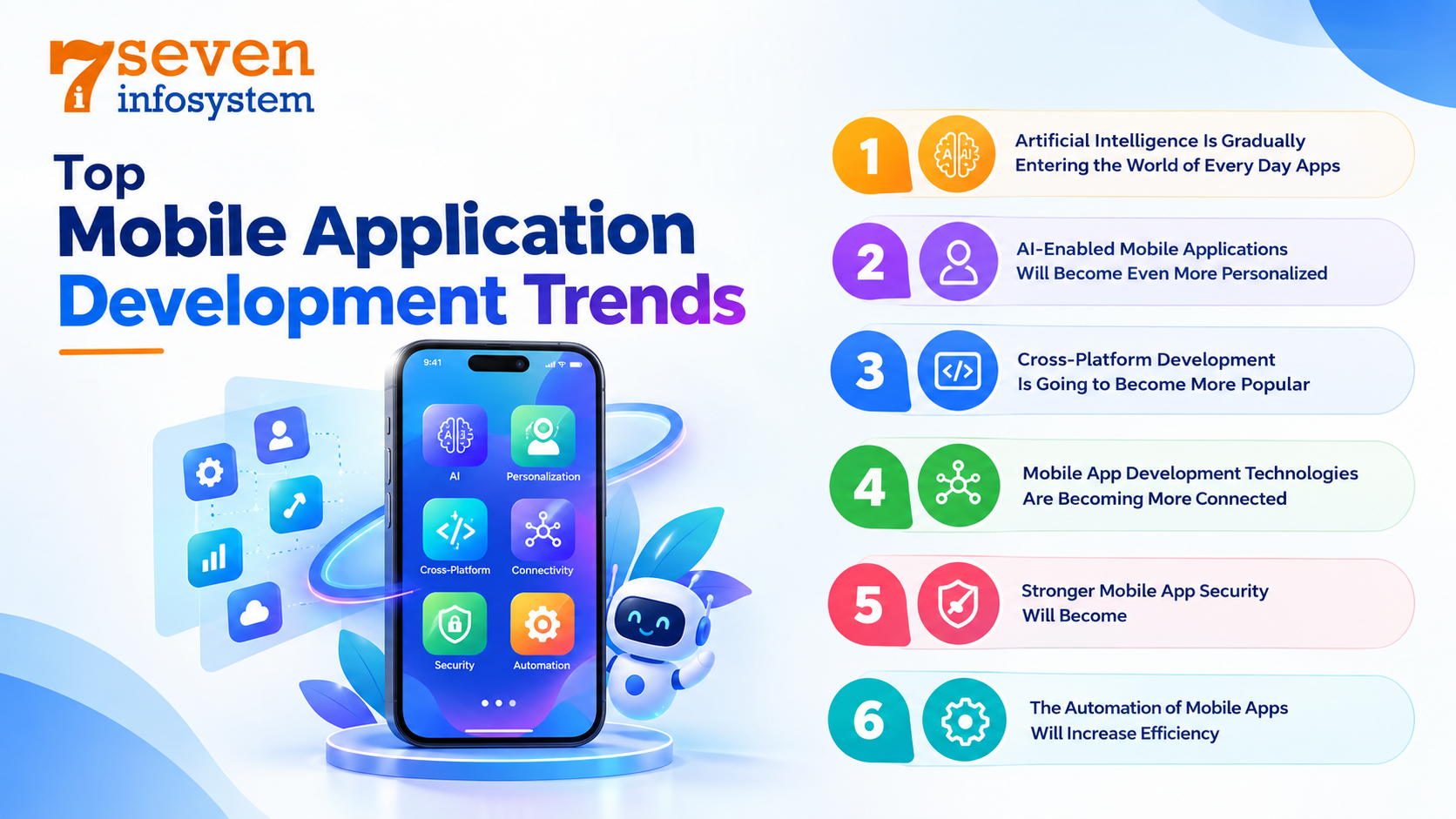
Artificial intelligence is gradually transitioning from experimental approaches to being incorporated into every-day apps. In 2026, businesses have started considering AI in mobile app development to provide responsive, customized and practical applications.
In other words, rather than adding artificial intelligence as some sort of separate functionality, developers can implement intelligent features throughout the app. For instance, an e-commerce app can analyze user behavior and make recommendations on products; a financial application can recognize abnormal activity; customer service app can use chatbots to handle basic queries.
With the help of generative AI, there are also new opportunities for creating apps that allow users to produce content, create summaries, perform searches across large sets of data or interact with the services using natural language.
What is important about this approach is that the proper use of AI should be helpful and solve the customer's problems. Implementation of AI just for the sake of implementing it could only complicate the product.
Therefore, businesses should start with analyzing the customer experience and then look into incorporating AI to improve that experience.
2. AI-Enabled Mobile Applications Will Become Even More Personalized
Personalization has always been a great thing, but now thanks to AI, it will become even more advanced.
Classical personalization will suggest goods based on the previous purchase history or show some content following simple preferences of a person. AI-enabled mobile applications will be able to analyze different signals and find patterns which cannot be discovered manually.
For instance, the application may find out when the user is actively using particular features of the application, get to know his preferences and offer him something relevant just in time. Fitness applications will become smarter and offer recommendations for exercises according to the activity of the user, whereas learning platforms will offer him particular lessons considering his progress.
In this case, an app becomes not just a product but also a service which adjusts itself to a particular person.
Of course, personalization needs responsible management of data. It is important to inform people about what exactly you collect and why.
3. Cross-Platform Development Is Going to Become More Popular
Development of apps separately for every operating system may take more time and effort. This is another reason why cross-platform development is appealing to many businesses.
Nowadays, it is possible to develop applications which can be used on different platforms and share the code base. This allows businesses to release their products faster and keep their consistency.
Cross-platform development is especially advantageous for those startups which need to validate their ideas fast or those companies which need to cover Android and iOS users without having separate development teams.
Nevertheless, cross-platform development does not always seem like the best solution for every single app development. The application may require some specific functions of the device or the platform itself.
This should be considered when making a decision.
4. Mobile App Development Technologies Are Becoming More Connected
The way mobile apps are built is changing. These apps don't work alone anymore. They might talk to cloud services, payment systems, tools for analyzing data, software for managing customers' devices like smartwatches and other outside services through connections.
Because of this the tools used for building apps are getting more connected. They are moving away from being apps and instead are becoming parts of bigger systems.
Cloud services, connections, databases that update in real time tools for analyzing data models that use artificial intelligence and tools that do tasks automatically can all work together. This helps make a digital experience.
For companies the way an app is built is just as important as how it looks. A nice design can't fix connections, bad handling of data, unreliable links to other systems or a weak base that supports the app.
5. Stronger Mobile App Security Will Become
As apps deal with more personal, financial and business information security cannot be seen as something that is checked off at the end.
Mobile app security is becoming a part of building a product. Developers must think about data protection, secure login methods, encrypted communication, access controls, API security and ways to prevent security issues from the very start of a project.
Biometric authentication, -factor authentication secure tokens and better identity management are becoming more common. At the time teams are focusing more on how sensitive information is kept and sent.
Security is especially important for apps in areas, like banking, healthcare, education, shopping and business services.
A security-first approach can lower risks. Help keep both the company and its users safe. Regular checks and updates are also important because threats keep changing after an app is released.
6. The Automation of Mobile Apps Will Increase Efficiency
Automation is affecting not only the front-end aspect of the applications but the development process itself.
With automated tests and smart workflow, automation of mobile apps can eliminate redundancy and increase consistency. Testing, deployment, monitoring, notification, data processing, and other redundant actions can be automated by development teams.
Users can also benefit from automation by performing some redundant tasks automatically through their app. An application could categorize expenses, create reminders, process some requests, or perform some actions depending on the certain condition.
The benefits of automation appear due to the elimination of unnecessary friction. The fewer steps the user needs to complete a certain action, the easier it will be for him.
For the development team, automatic testing becomes crucial with an increasing complexity of the app.
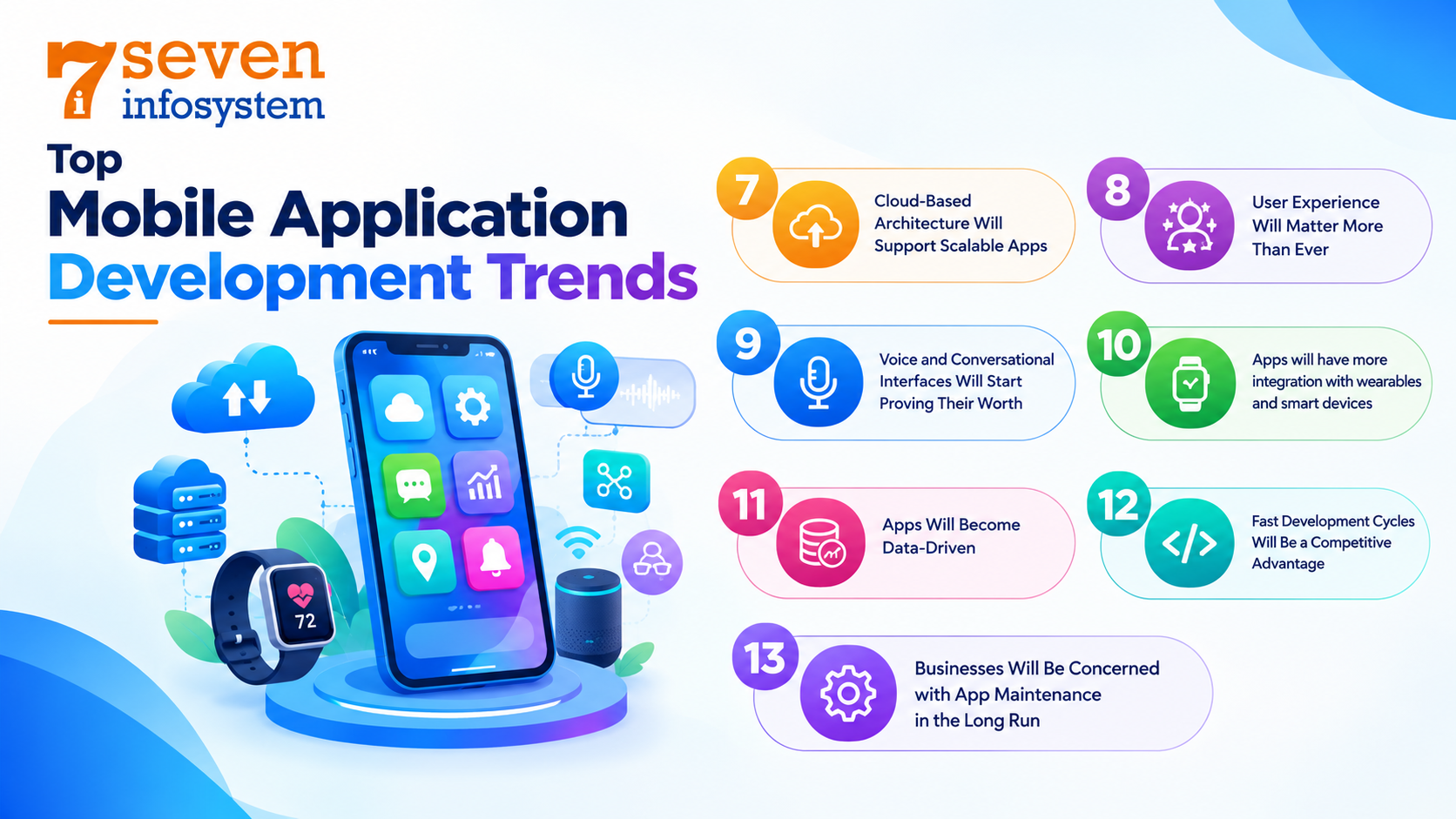
7. Cloud-Based Architecture Will Support Scalable Apps
Cloud technology keeps playing a part in today’s app infrastructure.
Depending only on local device resources apps can use cloud services for storage, login, data analysis, processing, databases and other, behind-the-scenes work.
This method can help businesses grow their apps as more people use them. A small app might start with a user and later need to support thousands or even millions.
Cloud infrastructure gives the flexibility needed to meet shifting demand.
Cloud services also help development teams add features without rebuilding the whole backend.
For businesses planning long-term growth cloud architecture becomes a part of the tech strategy.
8. User Experience Will Matter More Than Ever
User experience will be more important than ever. Technology can get attention. How easy it is to use decides if people keep using an app.
In 2026 the best apps will try harder to make things smooth. People want things to load fast to move around easily to see things clearly to have designs that work for everyone and to have interactions that make sense.
A mobile app should not make users learn how it works. Important actions need to be easy to find. Forms should be simple. Extra steps should be taken out. This is when user research and testing are really helpful. By guessing what customers need, teams can watch real users use early versions and see where people get stuck. An app that is very advanced but hard to use might have trouble.. An app that is simple and solves one problem really well can get people to stay and be loyal.
9. Voice and Conversational Interfaces Will Start Proving Their Worth
Individuals are getting used to communicating with technology via natural language.
Voice search and conversational interface can be used to increase usability and help people obtain information faster if there is no time to go through the application menu.
For instance, a client can contact an app and ask something, get some information, set an appointment, and find out about a certain service without the need to go through the screens of the device.
Such conversational interfaces using AI can be more flexible compared to menu-driven interfaces.
Nevertheless, voice functionality should be added where it adds real value. There is no need to add it to all applications since not all of them require a voice assistant.
10. Apps will have more integration with wearables and smart devices
The mobile phone is becoming a hub for an increasingly diverse range of connected devices.
These include smartwatches, fitness trackers, smart home devices, health monitors, and any other types of connected devices, which can exchange data with mobile applications. It opens up the possibility of creating applications, which go beyond the limits of the mobile phone screen.
For instance, the fitness app can access data about activities collected by a wearable device and offer relevant analytics to its user. The smart home application can help control the connected devices remotely.
All this requires taking into account information flows and consistency of the whole experience while developing apps.
11. Apps Will Become Data-Driven
Data has become one of the most valuable resources for digital businesses.
Modern applications can collect information about feature usage, customer behavior, conversion rates, engagement and performance. When analyzed responsibly this information can help businesses make product decisions.
By guessing which feature users prefer, product teams can examine actual behavior. They can identify where users leave a process, which features receive the engagement and which parts of the application need improvement.
The key is to collect data rather than collecting everything. Businesses should have a purpose, for analytics and respect privacy requirements while using the information.
12. Fast Development Cycles Will Be a Competitive Advantage
The needs of customers change rapidly. Therefore, there must be an ability to adapt quickly without compromising the quality.
Current frameworks, cloud platforms, automation tests, reusable code, and continuous integration allow the development team to release updates more effectively.
This does not imply forcing everything into production. It just means the team releases the improvement, measures its effects, receives feedback, and keeps working on the application.
This way, the company can learn from users instead of working for many months on creating the feature based only on assumptions.
For those who want to develop an application on mobile, it would be beneficial to analyze not only the developer's professional qualities but also the way they work on it.
13. Businesses Will Be Concerned with App Maintenance in the Long Run
Creating an application is not the end result.
The operating system will change, security threats will appear, new device functionality will arise, and user requirements will change. An application without proper maintenance will soon become obsolete.
Updates will improve its performance, solve security problems, ensure compatibility, and add some features.
That’s why it is important for companies to include maintenance costs in their budgeting process. This is possible with the help of a competent development company that provides such services.
It means that the selection of mobile app development solutions shouldn’t be limited only by their launching phase. The best solution is the one that will be able to develop together with the company.
How Businesses Should Prepare for Trends of Mobile App in 2026
It isn't required to follow every trend that emerges in technology.
First, identify what kind of problem the application is supposed to solve. Then, determine its target audience and how they usually solve the particular problem now. Finally, find out what technology can help to improve that situation.
For instance, AI technology can be needed when there is a need to personalize or automate something. Cross-platform development technology can be used if speed is needed for building an application on various platforms. Advanced security technology can be used if an application works with confidential data.
Collaborating with a professional mobile app development company from Rajkot will allow businesses to choose the right technology considering their requirements and budgets.
New is not always better. It should add some value and be applicable at the same time.
Mobile Application Development and the Role of Web Development
Mobile applications represent just one component of the larger digital ecosystem. There are cases when other technologies such as websites, dashboards, administrative panels, APIs, and web portals for clients are required by some enterprises.
Thus, there are occasions when it is useful for an enterprise to use both a mobile development company and a web app development company. Coordination of activities will help integrate all these components into a coherent whole.
As an example, we can take an e-commerce business that needs a mobile application for its clients, a website for computer users, and an administrative panel to manage products and orders.
What Should Businesses Look for in a Mobile App Development Partner?
Choosing a development partner is an important decision because the relationship often continues long after the application launches.
Businesses should evaluate technical experience, communication, development methodology, testing practices, security standards, portfolio quality, and post-launch support.
It is equally important to inquire about the approach adopted by the company for requirement and product development strategy. A good partner would not just develop all the features that have been requested. He would point out potential issues and present alternative solutions.
The selection of a partner would impact the performance of the application whether the business develops its first application or updates an existing one.
Conclusion
Mobile applications have to become more intelligent, connected, secured, personal and efficient. New technologies such as AI development solution, cross-platform solutions, cloud infrastructure, automation tools, connected devices and better security measures affect business approaches towards building digital products.
But not technology makes an application successful in any way. Successful applications will keep solving customers' problems and providing users with a simple and stable experience.
In case a company considers building an application in 2026, it should take all factors into account but not individual trends. The company needs to think about how the technology will fit into its overall business strategy, how scalable the application will be and how it will keep delivering value.
Using a correct product strategy together with Mobile Application Development approach, a business can create an application that will not only remain relevant but also ready for innovations.
FAQs
1. What are the biggest mobile app development trends in 2026?
AI-powered experiences, cross-platform development, stronger security, automation, cloud technologies, personalization, and connected devices are among the major trends shaping mobile applications in 2026.
2. Is cross-platform app development a good choice for businesses?
It can be a good choice when a business wants to reach multiple platforms efficiently. The right approach depends on the application's performance, features, budget, and technical requirements.
3. How is AI changing mobile applications?
AI can improve personalization, recommendations, automation, search, customer support, content generation, and decision-making, helping applications deliver more relevant experiences.
4. Why is mobile app security important?
Mobile applications often handle personal and financial information. Strong security practices help protect user data, reduce vulnerabilities, and build trust in the application.
5. Should businesses update their mobile apps regularly?
Yes. Regular updates help maintain compatibility with new operating systems and devices, address security issues, improve performance, fix bugs, and introduce useful improvements.